
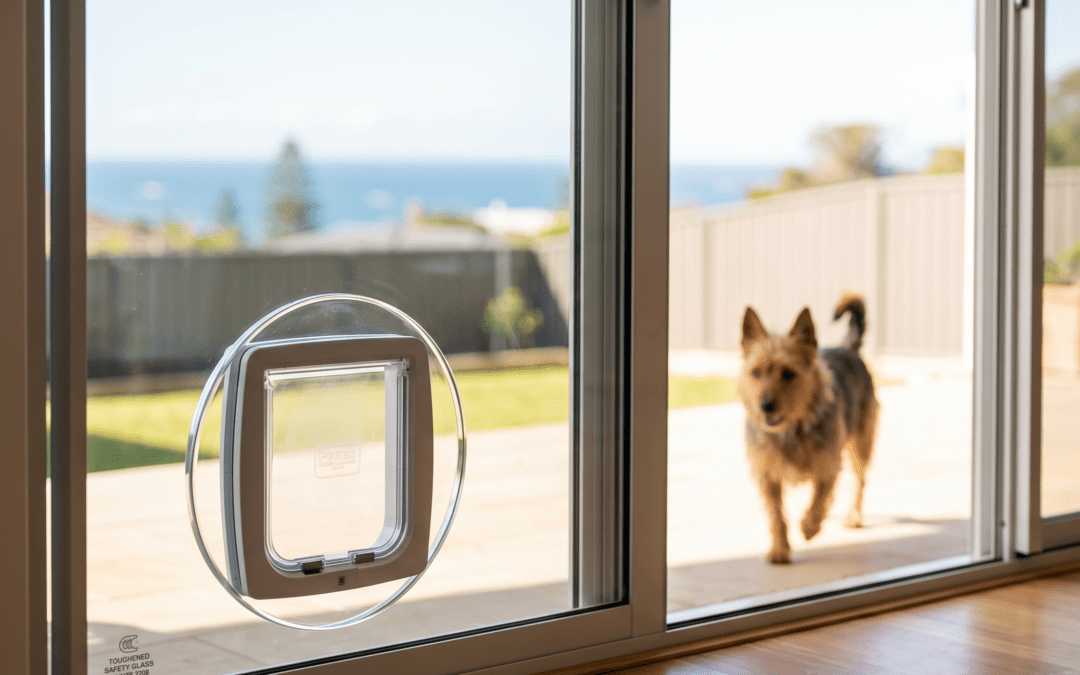
The number one objection we hear from homeowners considering a pet door in glass is some version of “won’t it weaken the glass?” or “isn’t that a security risk?” or “what if my kid runs into it?”
These are fair questions. Cutting a hole in a glass panel sounds like it should make it weaker. Common sense says so. But common sense is wrong here, because the glass panel with the pet door is not your original panel with a hole cut into it. It is an entirely new panel, engineered and manufactured with the opening built in from the start.
Once you understand how toughened glass works and what Australian Standards require, the safety concern flips. A properly installed pet door in glass is not a compromise. In many cases, it is safer than the alternatives.
How the Glass Is Made
This is the detail that changes the conversation.
When you order a pet door in glass, the glazier does not take your existing glass panel and drill a hole in it. That would destroy toughened glass instantly (it shatters under any localised modification after tempering).
Instead, a brand-new glass panel is manufactured. The pet door opening is cut into the raw glass (called annealed or float glass) at the factory. All edge work, smoothing, and shaping happens at this stage. Then the entire panel, opening included, goes through the toughening process.
Toughening involves heating the glass to approximately 620 degrees Celsius and then rapidly cooling it with jets of air. This creates a state of high compression on the outer surfaces and tension in the core. The result is a panel that is four to five times stronger than untreated glass of the same thickness.
The critical point: the opening is part of the toughened structure. The edges of the hole are tempered with the same strength profile as the rest of the panel. The glass around the opening is not weaker than the rest of the panel. It is the same material, treated the same way, with the same safety rating.
What Australian Standards Require
Every glass panel in a door or low-level window in an Australian home must comply with AS/NZS 2208 (Safety Glazing Materials in Buildings) and AS 1288 (Glass in Buildings: Selection and Installation).
These standards specify that glass in human impact areas must be safety glass, either toughened or laminated. A sliding door, a fixed panel beside a door, or any window below 800mm from the floor falls into this category.
When a licensed glazier installs a pet door panel, the replacement glass must meet the same standard as the original panel. That means:
- Toughened safety glass, certified to AS/NZS 2208
- Correct thickness for the panel size and location
- Manufacturer’s stamp etched or printed in the corner confirming compliance
- Minimum edge distances maintained between the pet door opening and the panel edges
The pet door installation does not create an exemption or a lower standard. It must meet the same safety requirements as every other piece of glass in your home. And when installed by a licensed glazier, it does.
How Toughened Glass Breaks (and Why That Matters)
If toughened glass does break, whether from a severe impact, a structural defect, or an extreme event, it shatters into small, roughly cubic pieces. These fragments are blunt-edged, not sharp. They fall rather than flying, and they are far less likely to cause serious cuts than standard float glass.
This breakage pattern is the entire purpose of toughened glass. It is designed to fail safely. The pet door opening does not change this behaviour. If the panel breaks, it breaks into the same safe fragment pattern as any other toughened panel.
Compare this to what happens with standard float glass (the type a handyman might use if they are not aware of the standards). Float glass breaks into large, jagged shards with razor-sharp edges. These shards can cause deep lacerations, and in a door or low window where children and pets are at face and body height, the injury risk is serious.
If your home has older glass panels that were installed before current standards were enforced (pre-mid-1990s), there is a real chance that some of your existing door glass is standard float, not toughened. In that case, replacing it with a compliant toughened panel for a pet door actually improves the safety of your home. You are upgrading non-compliant glass to current standards as part of the same job.
Security: The Real Picture
The security question is understandable. A pet door is an opening in your home. But the actual security risk is lower than most people assume.
Size Limitations
Most pet doors for cats and small to medium dogs have openings between 15cm and 35cm wide. A human cannot fit through an opening this size. Even large dog doors (40cm to 50cm wide) are too small for an adult to pass through.
The theoretical risk is a small child being pushed through by an accomplice, but this scenario requires a level of planning and targeting that is far removed from typical residential break-ins. Opportunistic burglars look for open windows, unlocked doors, and weak entry points. A locked pet door flap in a toughened glass panel is not a weak entry point.
Locking Mechanisms
Quality pet door brands include a locking panel or sliding cover that blocks the flap from the inside. When locked, the opening is sealed and the flap cannot be pushed open from outside. Brands like Pettek and Pet Doors Australia include multi-point locking covers as standard.
For additional security, some models offer electronic access (microchip-activated or collar-key activated) that only opens for your registered pet. This prevents neighbourhood cats, possums, or other animals from entering.
Compared to the Alternatives
A pet door in a toughened glass panel is more secure than several common alternatives:
- A wall-mounted pet door with a plastic tunnel (can be pried out of the wall)
- A sliding door left cracked open for the pet (anyone can open it fully)
- An insert panel wedged into the sliding door track (can be popped out of the track)
- An unlocked window left open for ventilation with the pet coming and going
The glass panel itself is the security barrier. The pet door flap is a controlled opening within that barrier. When locked, the barrier is complete.
Impact Resistance in Daily Use
Families with children and pets put glass under more stress than the average household. Balls hit windows. Dogs barrel through doors. Kids press their hands and faces against glass. This is normal life.
Toughened glass handles this well. Its impact resistance is four to five times higher than standard glass. A pet door panel takes the same knocks and bumps as any other glass panel in your home, and it handles them the same way.
The pet door flap itself absorbs most of the impact from your pet going through. Quality flaps are made from flexible, durable materials (usually polycarbonate or UV-stabilised plastic) that flex on impact rather than transferring force to the glass. The flap is a moving part designed to be pushed hundreds of times a day. The glass is the fixed structure around it.
What About Storms and Severe Weather?
In the Illawarra and along the NSW coast, storms bring strong winds, heavy rain, and occasionally debris. The question is whether a glass panel with a pet door opening performs differently in severe weather than a solid panel.
The glass itself is not affected. A toughened panel with a pet door opening has the same wind load rating as a solid panel of the same thickness and size (assuming the opening meets the manufacturer’s minimum edge distance specifications).
The pet door flap is the variable. In very strong winds, the flap can be pushed open if it is not locked. This allows wind-driven rain into the home. The solution is simple: lock the pet door flap before severe weather hits. Most models have a slide-lock or cover panel that seals the opening completely.
If you live in a high wind exposure area, look for pet door models with magnetic or multi-seal flaps that provide a tighter closure during normal use. Your glazier can recommend the best option for your location.
The Bottom Line on Safety
A pet door installed in a toughened glass panel by a licensed glazier is:
- Manufactured to the same Australian Standard as every other safety glass panel in your home
- Engineered with the opening built into the toughened structure, not cut after the fact
- Designed to break safely if it ever fails
- More secure than leaving a door cracked open or using an insert panel
- Equivalent in impact and wind resistance to a solid panel when the flap is locked
The safety concern is valid to raise. But the answer, backed by the standards and the engineering, is that a properly installed pet door in glass does not compromise your home’s safety. In homes with older, non-compliant glass, it improves it.
Ready to Install?
If you have been putting off a pet door because of safety concerns, talk to our team. We will walk you through the glass specifications, the pet door options, and the compliance details so you can make a confident decision. We service Wollongong, Sydney, the Illawarra, and the Southern Highlands.
Recent Comments