
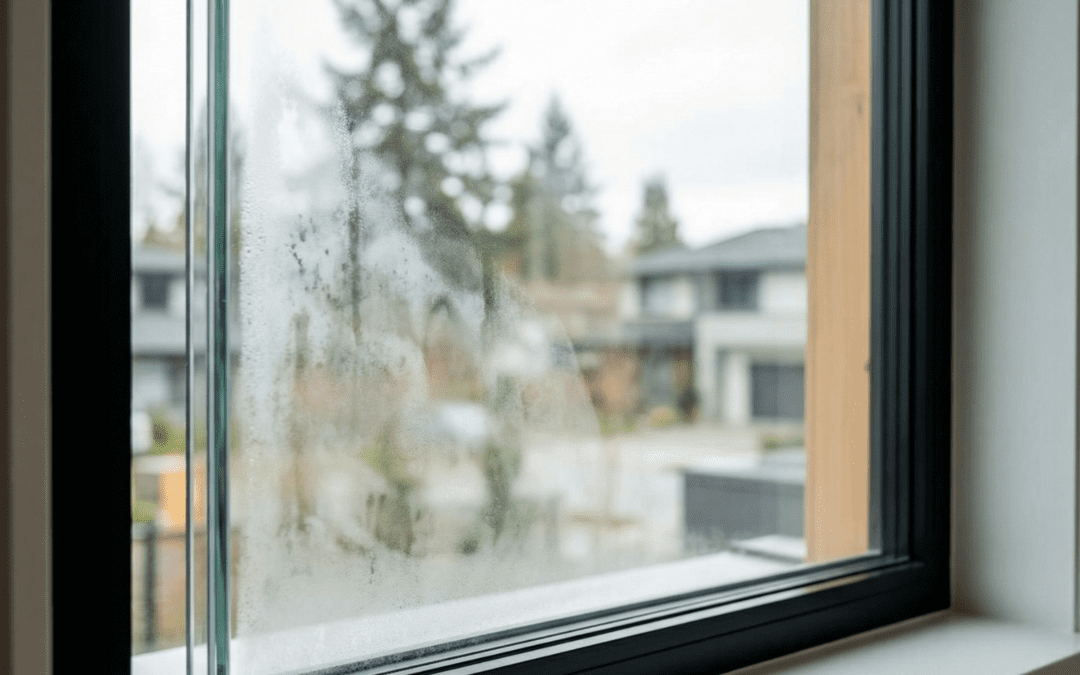
You have probably noticed it on a cold morning. A milky haze sitting between the two panes of your double glazed window. You try wiping it from the inside. Nothing changes. You try the outside. Still there. Because the fog is not on the glass. It is trapped inside it.
This is one of the most common glass problems we see across Wollongong, Sydney, and the Illawarra, and one of the most misunderstood. Homeowners spend months trying DIY fixes, drilling holes, running dehumidifiers, or applying anti-fog sprays to the surface. None of it works, because the problem is not moisture in your room. It is a failed seal inside the glass unit itself.
Here is what is actually happening, why it gets worse over time, and when you have no choice but to replace.
What Causes Fogging Between Panes
Double glazed windows (also called insulated glass units, or IGUs) are made of two sheets of glass separated by a spacer bar and sealed around the edge. The gap between the panes is filled with dry air or argon gas. A small desiccant strip inside the spacer bar absorbs any residual moisture during manufacturing.
The seal around the edge is the critical component. It keeps moisture out and keeps the insulating gas in. When that seal fails, humid air from outside slowly enters the gap. The desiccant absorbs it for a while, but eventually it becomes saturated. At that point, moisture condenses on the inner glass surfaces, and you see fog.
The process is gradual. You might notice a slight haze in one corner first. Over weeks or months, it spreads across the pane. On cold mornings, it looks worse because the temperature difference increases condensation. On warm afternoons, it may seem to disappear, which tricks homeowners into thinking the problem has fixed itself. It has not. The moisture is still inside the unit. It is just evaporating temporarily.
Why Seals Fail
Several factors cause edge seals to break down:
Age. Every seal has a lifespan. Most quality IGUs last 15 to 25 years before the seal begins to deteriorate. Budget units with lower-quality sealants may fail in under 10 years.
UV exposure. Windows that face north or west in Australia cop the most direct sunlight. UV radiation breaks down the sealant material over time. North-facing windows tend to fail before south-facing ones in the same home.
Heat cycling. Glass expands when hot and contracts when cold. Every daily temperature cycle puts stress on the seal. Over thousands of cycles, the sealant fatigues and develops micro-cracks that allow moisture in.
Salt air. On the Illawarra coast, salt-laden air accelerates sealant degradation. Homes within a few kilometres of the ocean often see seal failures earlier than inland properties.
Poor original installation. If the IGU was not seated correctly in the frame, or if the drainage system in the frame is blocked, water can pool against the edge seal and break it down prematurely.
What the Fog Does to Your Glass
Here is the part that most homeowners do not realise until it is too late: the fog itself damages the glass.
Moisture trapped between the panes contains dissolved minerals. As the moisture evaporates and recondenses through daily temperature cycles, those minerals are deposited on the inner glass surfaces. Over time, they etch into the glass, creating a permanent haze that cannot be cleaned even if the seal is repaired.
If you catch a failed seal early (within the first few weeks of noticing fog), it is sometimes possible to replace just the IGU without the mineral etching becoming permanent. If you wait six months or more, the inner glass surfaces are usually damaged beyond recovery, and the entire unit must be replaced.
This is why “wait and see” is the most expensive approach to foggy windows.
DIY Fixes That Do Not Work
The internet is full of suggestions for fixing foggy double glazing at home. Here are the most common ones and why they fail:
Drilling holes to vent moisture. Some videos show people drilling small holes in the glass or spacer bar to allow moisture to escape. This destroys the insulating properties of the unit entirely. You now have a double glazed window that performs like single glazing, with two holes in it. The fog may reduce temporarily, but the unit will fog again because there is no seal to keep new moisture out.
Dehumidifiers in the room. Running a dehumidifier reduces moisture in your room, not inside the sealed glass unit. It will have zero effect on the fog between the panes.
Anti-fog sprays. These are designed for car windscreens and bathroom mirrors. They work on the surface of glass. They cannot reach the inner surfaces of a sealed IGU.
Replacing the desiccant. Some repair services offer to open the unit, replace the desiccant strip, and reseal. In theory, this addresses the cause. In practice, the results are inconsistent. The original factory seal is made under controlled conditions with specialised equipment. A field repair rarely matches the same quality, and the repaired unit often fogs again within a year or two.
When Replacement Is the Only Option
For most homeowners with foggy double glazed windows, full IGU replacement is the correct fix. Here is why:
The seal has failed. Patching a failed seal is a temporary measure. The sealant has reached the end of its useful life, and a spot repair does not reset the clock on the rest of the seal.
The glass is etched. If mineral deposits have built up on the inner surfaces, no amount of resealing will restore clarity. The glass itself is damaged.
Energy performance is compromised. A failed seal means the insulating gas (air or argon) has leaked out and been replaced by humid air. The window is no longer insulating as designed. Your heating and cooling costs increase as a result.
The cost difference is small. The labour involved in removing the old IGU, preparing the frame, and installing a new one is the same whether you are installing a repaired unit or a brand-new one. The incremental cost of a new IGU over a repair is often modest, and you get a full warranty on the new unit.
Single Glazed Windows Fog Too (But for Different Reasons)
It is worth noting that condensation on single glazed windows is a completely different issue. If you see water droplets on the inside surface of a single-pane window, that is room humidity condensing on cold glass. It is not a glass fault. It is a ventilation issue.
Single glazed glass is a poor insulator, so the inner surface gets very cold on winter mornings. When warm, humid indoor air contacts that cold surface, moisture condenses. The fix is better ventilation (opening windows, using exhaust fans, reducing indoor humidity sources) rather than glass replacement.
That said, if your single glazed windows are old, poorly sealed, or non-compliant with current safety standards, replacing them with modern safety glass solves the condensation issue and brings your home up to code at the same time.
How to Check Your Windows
Here is a simple test: run your finger across the foggy area. If you can feel the moisture or wipe it away, it is on the surface (a ventilation issue). If the fog is behind the glass and you cannot touch it, the seal has failed and you are looking at an IGU replacement.
Also check the edges of the glass unit for visible sealant cracks, gaps, or discolouration. These are signs that failure is underway even if fog has not appeared yet.
What Replacement Involves
Replacing a failed IGU is a straightforward job for a licensed glazier. The process involves removing the failed unit from the frame, cleaning and inspecting the frame for corrosion or damage, and fitting a new factory-sealed IGU to the correct specifications.
If the frame is in good condition, the job is typically completed in a single visit. If the frame has corrosion or damage from salt air, that needs to be addressed before the new glass goes in. Putting a new IGU into a compromised frame shortens the lifespan of the new unit.
Get Your Foggy Windows Assessed
If you have double glazed windows that are fogging up, do not wait for the etching to set in. The sooner you act, the simpler and cheaper the fix. Contact our team for an assessment. We service Wollongong, Sydney, the Illawarra, and the Southern Highlands.
Recent Comments