
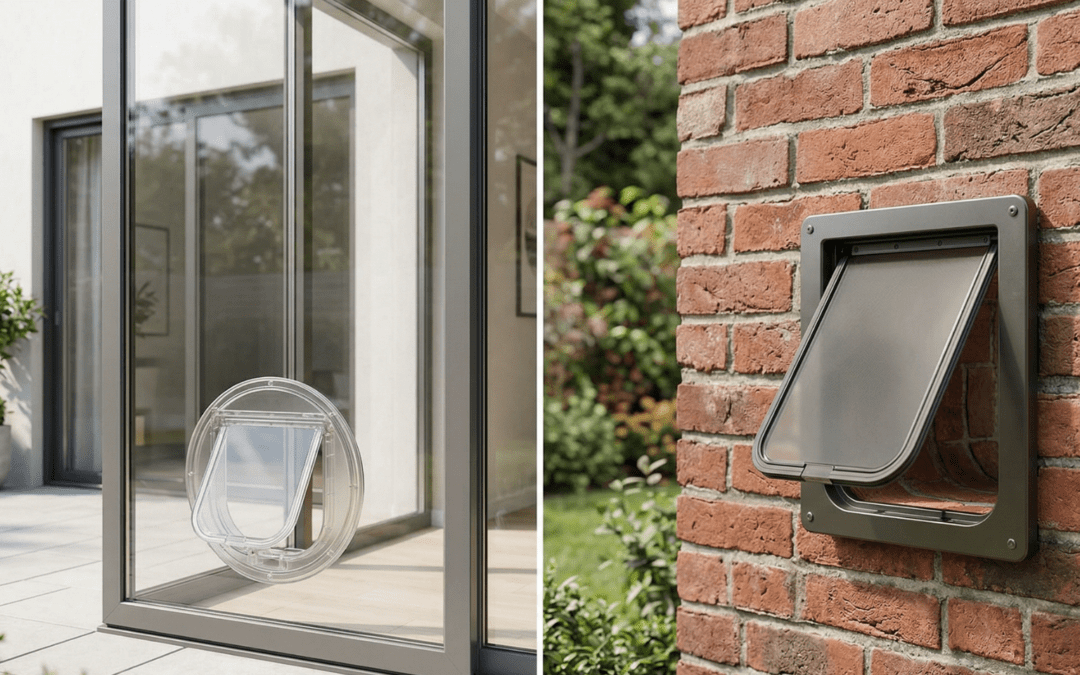
You have decided your dog or cat needs a pet door. Good call. Letting them come and go on their own means no more 6am wake-up scratching, no more muddy paw prints on the back door from waiting, and no more getting up from the couch every 20 minutes.
But now you have a second decision: do you install the pet door in a glass panel or through a wall?
Both options work. Both have been around for years. But they are very different in terms of cost, installation, insulation, appearance, and long-term durability. Most websites selling pet doors gloss over this comparison because they want you to buy their product regardless of where it goes. This is a no-spin breakdown of both options so you can make the right choice for your home.
How Each Installation Works
Pet Door in Glass
A pet door in glass involves removing your existing glass panel (usually in a sliding door or fixed panel) and replacing it with a new sheet of toughened glass that has a hole pre-cut for the pet door. The pet door flap is then mounted into that hole.
The key point is that the hole must be cut before the glass is toughened. You cannot drill or cut toughened glass after it has been tempered. It will shatter. That means the glass panel must be custom-manufactured with the opening in the correct position and at the correct size for your chosen pet door.
This is a licensed glazier job. The old panel comes out, the new pre-cut panel goes in, and the pet door is fitted on site.
Pet Door in a Wall
A wall-mounted pet door involves cutting a hole through your exterior wall (brick, timber, weatherboard, or cladding) and fitting a tunnel liner that connects the inside to the outside. The pet door flap is mounted on one or both ends of the tunnel.
This is typically done by a handyman, carpenter, or the homeowner. It requires measuring and marking the opening, cutting through the wall material, framing the tunnel, sealing against weather, and fitting the flap.
Cost Comparison
Wall-mounted pet doors are generally cheaper upfront if you are doing a straightforward timber or weatherboard wall. A basic wall kit plus installation by a handyman might run $200 to $500 depending on the wall type and pet door brand.
Glass-mounted pet doors cost more because you are paying for a new custom-cut toughened glass panel plus professional installation. Expect $400 to $900 for a standard sliding door panel replacement with pet door, depending on glass size and pet door brand.
However, the upfront cost does not tell the full story. Wall installations sometimes require patching, waterproofing, and finishing work that adds to the total. If the wall contains insulation, electrical wiring, or plumbing, the cost jumps significantly. And if the job is done poorly, you can end up with water ingress, drafts, or structural issues that cost more to fix than the pet door itself.
Glass installations, by contrast, are contained. The old glass comes out, the new glass goes in. There is no structural modification to your home and no risk of hitting services inside the wall.
Insulation and Weatherproofing
This is where the two options differ the most, and where wall installations often fall short.
Glass
A toughened glass panel with a pet door maintains the same thermal performance as the glass it replaced (minus the flap opening). When the pet door flap is closed, the opening is sealed by the flap itself. Quality pet door brands like Petway, Pettek, and Pet Doors Australia use magnetic seals or brush strips to reduce drafts.
The glass panel itself is a continuous, sealed surface. There are no gaps around the frame because the glass sits in the existing door or window frame exactly as the original panel did.
Wall
A wall-mounted pet door cuts through your building envelope. Even with careful installation, the tunnel through the wall creates a thermal bridge. Cold air passes through the tunnel in winter. Hot air passes through in summer. The flap provides some barrier, but the tunnel sides are often uninsulated.
In brick walls, the tunnel passes through the cavity between the inner and outer skins. This cavity is designed to be a drainage plane for moisture. Cutting through it and fitting a tunnel can compromise the cavity’s function if not sealed correctly.
In timber-framed walls with insulation, you are removing a section of insulation to create the tunnel. That section of wall now has zero insulation around the pet door, which creates a cold spot in winter and a hot spot in summer.
None of these issues are unsolvable, but they do require careful workmanship. A rushed wall installation is the number one cause of drafty, leaky pet doors.
Appearance
This comes down to personal preference, but glass-mounted pet doors are generally considered more visually clean.
A pet door in a glass panel looks built-in. The glass surface is smooth and uninterrupted except for the flap, which sits flush. From the outside, it looks intentional.
A wall-mounted pet door often looks like an afterthought, particularly on brick or rendered walls where the cut edges need to be finished. The tunnel protrudes slightly on both sides, and the surround may not match the wall colour or texture exactly.
For renters, appearance matters for a different reason: a glass panel can be swapped back to a standard panel when you move out, leaving no trace. A hole in a wall is permanent and will need to be patched and repainted, which may affect your bond.
Safety and Compliance
Glass-mounted pet doors must use toughened safety glass that complies with AS/NZS 2208. This is non-negotiable. The replacement panel is manufactured to the same safety standard as the original glass, which means it breaks safely if impacted. A licensed glazier handles the compliance side of this automatically.
Wall-mounted pet doors have no specific Australian Standard governing their installation, which means quality varies wildly. The biggest risks are:
Water ingress. If the tunnel is not sealed correctly against the wall, rainwater can enter the wall cavity and cause mould, rot, or structural damage over time.
Structural compromise. Cutting through a load-bearing wall without proper framing can weaken the wall. This is uncommon for small pet doors but becomes a risk with larger openings for big dogs.
Pest entry. A poorly sealed wall tunnel can create gaps that allow insects, mice, or even snakes (this is Australia, after all) to enter the wall cavity.
Durability
Glass-mounted pet doors last as long as the glass panel itself, which is typically 15 to 20 years or more. The pet door flap may need replacing after 5 to 10 years depending on use and UV exposure, but swapping a flap is cheap and simple.
Wall-mounted pet doors are more exposed to weather, particularly on the exterior side. The tunnel liner can degrade, seals can crack, and the wall surround can deteriorate. In coastal areas like the Illawarra, salt air accelerates this degradation.
Which One Is Right for You?
Choose glass if:
- You have an existing glass sliding door or fixed glass panel in a convenient location
- You rent and need a reversible option
- You want a clean, built-in appearance
- You prefer a professional installation with no structural modification to your home
- You live in a coastal area where weatherproofing matters
Choose wall if:
- You do not have a suitable glass panel near the area where your pet needs access
- You have a thick brick or double-brick wall with no services inside
- You are comfortable managing the waterproofing and finishing yourself
- Budget is the primary concern and you are confident in the installer’s quality
For most homeowners we work with across Wollongong, Camden, and Sydney, glass is the preferred option because it avoids cutting into the building structure and the result looks cleaner. But both options have their place depending on your home’s layout.
Get a Quote for a Pet Door in Glass
If you want to give your pet their own access without modifying your walls, reach out to our team for a straightforward quote. We supply and install pet doors from Pettek, TransCat, Pet Doors Australia, and custom options to suit dogs and cats of all sizes.
Recent Comments