
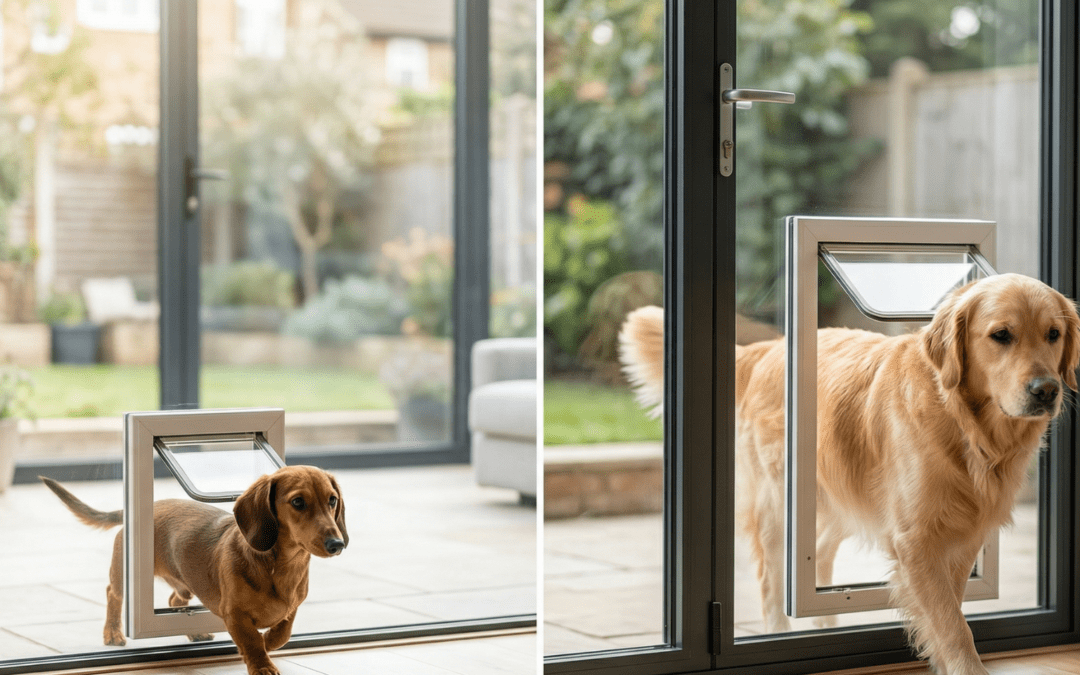
Getting the wrong size pet door is one of the most common mistakes homeowners make. Too small, and your dog squeezes through awkwardly or refuses to use it at all. Too large, and you lose insulation, security, and weather sealing for no reason.
The sizing process is simple once you understand it, but most pet door brands complicate it with vague size labels like “small,” “medium,” and “large” that do not correspond to any standard. A “medium” from one brand fits a completely different range of animals than a “medium” from another.
This guide gives you a clear method for measuring your pet and matching them to the right opening size, plus a breed-by-breed reference table so you can shortcut the process if you already know your dog or cat’s breed.
The short answer: measure your pet’s shoulder height and shoulder width while they stand on a flat surface. The opening should be at least 2.5cm taller than the shoulder height and 5cm wider than the shoulder width. As a guide, most cats suit a 15cm by 20cm cat flap, a Staffy needs about 34cm wide by 40cm high and a Labrador about 34cm wide by 50cm high. Want us to check the size against your glass? Call 0424 154 448.
How to Measure Your Pet
You only need two measurements: shoulder width and shoulder height. Both are taken while your pet is standing on a flat surface.
Shoulder Height
Measure from the floor to the top of your pet’s shoulders (not the top of their head). This tells you how tall the pet door opening needs to be.
The opening should be at least 2.5cm (1 inch) taller than your pet’s shoulder height. This gives them clearance to walk through comfortably without ducking. Dogs that duck tend to hesitate, and hesitation leads to them not using the door at all.
Shoulder Width
Measure the widest point across your pet’s chest and shoulders. This tells you how wide the opening needs to be.
The opening should be at least 2.5cm wider than your pet’s shoulder width on each side, so 5cm wider in total. This gives them room to walk through naturally without brushing against the frame.
The Step-Over Height
This one gets overlooked constantly. The step-over height is the distance from the floor to the bottom edge of the pet door opening. For a pet door installed in glass, this is determined by where the hole is positioned in the panel.
For young, agile dogs, a step-over height of 5cm to 10cm is fine. For older dogs with joint issues, arthritic dogs, or very short-legged breeds, you want the step-over as low as possible (ideally under 5cm) so they do not have to lift their legs high to get through.
If you have a puppy, measure them now but size the door for their expected adult dimensions. Your glazier can position the opening height to work for both their current size and their grown size.
Breed-by-Breed Size Reference
The table below covers the most common dog and cat breeds in Australia with typical adult shoulder height and width ranges. Use these as a starting point, then confirm with your own measurements. Individual dogs within a breed can vary, especially mixed breeds.
Cats
| Breed | Shoulder Height | Shoulder Width | Recommended Opening |
|---|---|---|---|
| Domestic Shorthair | 23 to 25cm | 15 to 18cm | 15cm W x 20cm H (cat flap) |
| Domestic Longhair | 23 to 25cm | 16 to 20cm | 15cm W x 20cm H (cat flap) |
| Maine Coon | 25 to 30cm | 18 to 23cm | 18cm W x 25cm H (large cat / small dog) |
| Ragdoll | 25 to 28cm | 18 to 22cm | 18cm W x 25cm H (large cat / small dog) |
| Bengal | 23 to 27cm | 16 to 20cm | 15cm W x 22cm H (cat flap) |
For most domestic cats, a standard cat flap (roughly 15cm x 20cm opening) works well. Larger breeds like Maine Coons and Ragdolls may need an intermediate-size door.
Small Dogs
| Breed | Shoulder Height | Shoulder Width | Recommended Opening |
|---|---|---|---|
| Chihuahua | 15 to 22cm | 12 to 16cm | 15cm W x 20cm H |
| Jack Russell Terrier | 25 to 30cm | 18 to 22cm | 20cm W x 28cm H |
| Cavalier King Charles | 30 to 33cm | 20 to 24cm | 22cm W x 30cm H |
| French Bulldog | 28 to 33cm | 25 to 30cm | 28cm W x 30cm H |
| Miniature Dachshund | 13 to 18cm | 14 to 18cm | 15cm W x 18cm H (low step-over) |
| Miniature Schnauzer | 30 to 35cm | 20 to 24cm | 22cm W x 32cm H |
| Pug | 25 to 30cm | 22 to 26cm | 24cm W x 28cm H |
Note that French Bulldogs and Pugs are wider relative to their height. A door that is tall enough may still be too narrow if you only check the height.
Medium Dogs
| Breed | Shoulder Height | Shoulder Width | Recommended Opening |
|---|---|---|---|
| Border Collie | 45 to 52cm | 25 to 30cm | 28cm W x 42cm H |
| Staffy (Am. Staff) | 43 to 48cm | 30 to 38cm | 34cm W x 40cm H |
| Australian Cattle Dog | 43 to 50cm | 26 to 32cm | 30cm W x 42cm H |
| Cocker Spaniel | 38 to 42cm | 22 to 28cm | 26cm W x 38cm H |
| Beagle | 33 to 40cm | 22 to 28cm | 26cm W x 36cm H |
| Kelpie | 43 to 50cm | 24 to 30cm | 28cm W x 42cm H |
| Whippet | 44 to 50cm | 20 to 26cm | 24cm W x 42cm H |
Staffies are the breed we get asked about most. They are not especially tall, but they are wide through the chest. Many owners undersize the door by looking at height alone. Always measure width with a Staffy.
Large Dogs
| Breed | Shoulder Height | Shoulder Width | Recommended Opening |
|---|---|---|---|
| Labrador Retriever | 54 to 60cm | 30 to 36cm | 34cm W x 50cm H |
| Golden Retriever | 54 to 60cm | 30 to 36cm | 34cm W x 50cm H |
| German Shepherd | 55 to 65cm | 30 to 38cm | 34cm W x 52cm H |
| Rottweiler | 56 to 68cm | 35 to 42cm | 38cm W x 55cm H |
| Boxer | 53 to 63cm | 32 to 38cm | 36cm W x 52cm H |
| Doberman | 60 to 68cm | 30 to 36cm | 34cm W x 56cm H |
| Standard Poodle | 55 to 62cm | 28 to 34cm | 32cm W x 52cm H |
Extra Large Dogs
| Breed | Shoulder Height | Shoulder Width | Recommended Opening |
|---|---|---|---|
| Great Dane | 70 to 85cm | 38 to 48cm | 42cm W x 65cm H |
| Irish Wolfhound | 75 to 85cm | 36 to 44cm | 40cm W x 65cm H |
| Mastiff (English) | 68 to 78cm | 42 to 52cm | 46cm W x 60cm H |
| Bernese Mountain Dog | 60 to 70cm | 35 to 42cm | 38cm W x 58cm H |
Extra large breeds need the biggest available pet door, and in some cases, a custom-built door. Not all pet door brands go large enough for a Great Dane or Mastiff. If you have a giant breed, ask your glazier about custom options before ordering.
Multi-Pet Households
If you have more than one pet, size the door for the largest animal. A small dog or cat can use a door that is bigger than they need, but a big dog cannot fit through a door sized for a cat.
The one exception is security. If you have a cat and want to prevent neighbourhood cats from coming in, a cat-specific door with a microchip reader may be worth installing separately from a larger dog door. This depends on your home layout and how many glass panels you have available.
What Happens If You Get It Wrong
A pet door that is too small leads to one of two outcomes. Either your pet forces through it and damages the flap mechanism over time, or they refuse to use it and you are back to opening the door manually.
A pet door that is too large wastes energy and reduces security. A bigger opening means more air exchange, which means higher heating and cooling costs. It also means a larger gap for possums, snakes, or intruders to potentially access.
Getting the size right the first time avoids the cost of re-cutting a new glass panel. Remember, toughened glass cannot be modified after manufacturing. If the hole is the wrong size, the entire panel needs to be remade.
What the Size Means for the Glass Panel
A pet door in glass is cut into a toughened glass panel, so the glass stays strong and safe around the opening. A few things follow from that:
- Bigger pet doors need more glass around the flap, so a large or extra-large door may need a wider or taller panel than a small one.
- Small and medium doors often fit a standard panel, while large and extra-large doors are worth checking against your glass size.
- If your current glass is not toughened, we usually fit a new toughened panel with the pet door already built in. This keeps the glass in line with Australian safety rules.
We measure your existing glass and tell you whether the pet door fits the current panel or needs a new one, so there are no surprises on the day.
Most pet doors in glass go into a fixed or side glass panel rather than the sliding part of a door, which keeps the door working as normal. We also place the flap near where your pet already likes to go in and out, so they take to it quickly.
See a Real Pet Door Job
Want to see how a pet door looks in a real home? Take a look at our Balmain dog door project, one of many pet door installation jobs we have finished across Sydney and the Illawarra.
Use Our Live Quote Tool
If you know your pet’s measurements and want a quick estimate, try our pet door live quote tool for an instant price. Or if you would rather talk it through, get in touch with our team and we will help you pick the right door and size for your pet.
Or call us on 0424 154 448. We install dog doors in glass and cat doors in glass across Sydney and the Illawarra.
Recent Comments