
If you have ever been quoted for glass replacement, you have probably heard the terms “toughened” and “laminated” thrown around. Your glazier may have told you that one or the other is required for your window, door, or shower screen. But chances are, nobody explained why.
These are two very different products. They break differently, they cost differently, and they are required in different locations around your home. Choosing the wrong one does not just waste money. It can put your family at risk and leave your installation non-compliant with Australian Standards.
Here is a clear breakdown of what each type does, where each one is required, and where homeowners commonly get it wrong.
What Is Toughened Glass?
Toughened glass (also called tempered glass) is regular glass that has been heated to around 620 degrees Celsius and then rapidly cooled. This process creates high internal tension across the panel, which makes it roughly four to five times stronger than standard float glass of the same thickness.
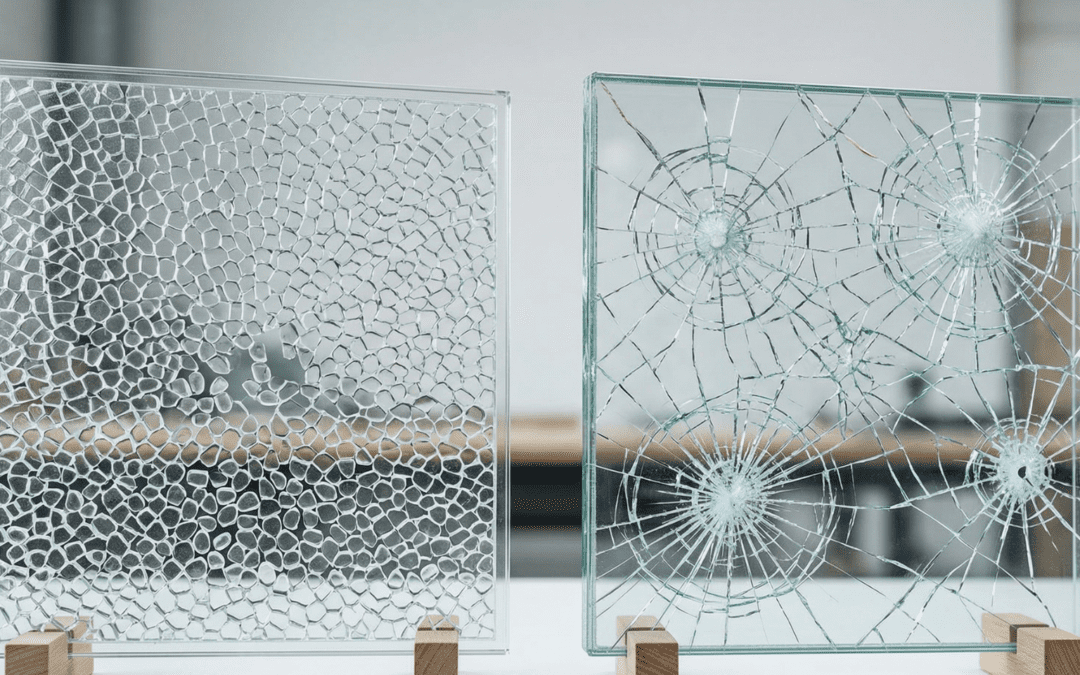
The key feature of toughened glass is how it breaks. When it fails, it shatters into thousands of small, relatively blunt pieces instead of large, sharp shards. This is why it is classified as “safety glass” under Australian Standard AS/NZS 2208.
You will find toughened glass in:
- Shower screens
- Glass doors (sliding, hinged, and frameless)
- Glass pool fences and balustrades
- Sidelights next to front doors
- Low-level windows (below 800mm from floor level)
- Any glass panel within 500mm of a doorway
- Pet door installations (the replacement panel must be toughened)
Strengths of Toughened Glass
Impact resistance. It handles knocks, bumps, and moderate impacts far better than float glass. This is why it is the standard choice for areas where people move around near glass.
Clean breakage pattern. If it does break, the small fragments are far less likely to cause serious cuts than large shards of standard glass.
Heat tolerance. Toughened glass handles temperature differences better than float glass, which matters for splashbacks near stoves and glass panels in direct sun.
Limitations of Toughened Glass
Cannot be cut after tempering. Once glass is toughened, it cannot be trimmed, drilled, or modified in any way. If the measurements are wrong, the panel must be remanufactured from scratch. This is why precision measurement matters, and why we use a FlexiJet 3D laser system for custom glass jobs.
Shatters completely. When toughened glass breaks, it breaks entirely. The whole panel comes down. There is no partial crack that holds together. For most applications this is a safety feature, but for some situations (like overhead glazing), it is a problem.
Vulnerable to edge damage. The edges of toughened glass are its weakest point. A chip or impact on the edge can cause the entire panel to shatter unexpectedly. This is a common issue with poorly installed glass where the edge contacts the frame or hardware.
What Is Laminated Glass?
Laminated glass is made by bonding two (or more) sheets of glass together with a plastic interlayer, usually polyvinyl butyral (PVB). The glass and plastic are fused under heat and pressure to create a single unit.
The defining feature of laminated glass is that it holds together when broken. The interlayer keeps the glass fragments attached, so instead of shattering and falling, the panel cracks but stays in place. This is the same technology used in car windscreens.
You will find laminated glass in:
- Overhead glazing (skylights, glass roofs, awnings)
- Balustrade infill panels (in some configurations)
- Windows in cyclone-rated zones
- Sound insulation applications
- Shopfronts and display windows where security is a priority
- Any location where falling glass would be dangerous
Strengths of Laminated Glass
Holds together when broken. This is its primary advantage. A broken laminated panel stays in the frame, which prevents glass from falling on people below and maintains a barrier (even if cracked) until the panel is replaced.
Better sound insulation. The PVB interlayer dampens sound transmission more effectively than a single pane of toughened glass. If noise reduction is a priority, laminated glass performs noticeably better.
UV protection. The interlayer blocks up to 99% of UV radiation, which reduces fading of furniture, flooring, and artwork near windows.
Can be cut (in some cases). Unlike toughened glass, some laminated glass can be cut on site, though this depends on the configuration and interlayer type.
Limitations of Laminated Glass
Lower impact resistance. Laminated glass is not as strong against direct impact as toughened glass. It will crack more easily from a knock, but it will hold together rather than shatter.
Higher cost. Laminated glass is generally more expensive than toughened glass of the same thickness because of the additional material and manufacturing process.
Heavier. Two sheets of glass plus an interlayer weigh more than a single toughened panel. This can matter for large panels where frame strength and hinge capacity are factors.
Where Australian Standards Require Each Type
This is the part most homeowners get wrong, usually because they rely on a handyman or an unlicensed installer who does not know the rules.
Australian Standard AS 1288 (Glass in Buildings) specifies where safety glass is required and, in some cases, which type. Here is a simplified summary:
Toughened glass is required (or acceptable) in:
- Doors and sidelights
- Low-level glazing (below 800mm)
- Glass within 500mm of a door edge
- Shower screens and bathroom enclosures
- Glass pool fences
- Glass balustrades (depending on configuration)
- Pet door panels
Laminated glass is required in:
- Overhead glazing (skylights, glass canopies, atriums)
- Any location where the glass is above people and could fall if broken
- Certain balustrade configurations where the glass is a structural barrier
Either type is acceptable in:
- Side windows in some locations
- Glass partitions (depending on height and location)
- Some balustrade designs
The standard is detailed and varies by situation. A licensed glazier will assess your specific installation and specify the correct type. Getting this wrong is not just a compliance issue. It is a safety issue.
Where Homeowners Get Upsold (or Undersold)
There are two common problems we see:
Upselling laminated where toughened is fine. Some suppliers push laminated glass for standard window and door replacements where toughened glass meets the standard. Laminated costs more, so this increases the quote without adding real benefit for the homeowner.
Underselling with float glass where safety glass is required. This is the more dangerous scenario. We regularly find standard float glass installed in human impact areas where the law requires safety glass. This is most common in older homes where a previous handyman or unlicensed installer replaced glass without checking the standards.
If you are unsure what type of glass is currently in your windows or doors, a licensed glazier can identify it. Toughened glass has a small etched stamp in one corner showing the Australian Standards mark. If there is no stamp, it may not be safety glass.
Which One Do You Need?
For most residential glass replacement jobs, toughened glass is the right choice. It is strong, safe, cost-effective, and meets the standard for doors, windows, shower screens, and pet door panels.
Laminated glass is the right choice when you need the panel to stay in place if it breaks (overhead glass, security applications) or when sound insulation is a priority.
In some cases, you can get toughened laminated glass, which combines both properties. This is more expensive but may be required for certain balustrade designs or high-security installations.
How They Break: The Main Difference
This is the part that matters most for safety.
Toughened glass breaks all at once into small, rounded pieces that are far less likely to cause a serious cut. Laminated glass cracks but stays in one piece, held together by the plastic layer, so it keeps covering the opening even after it breaks. Both are Grade A safety glass under AS/NZS 2208, so both are much safer than the plain annealed glass found in many older homes.
Toughened vs Laminated FAQ
Is toughened or laminated glass stronger?
Toughened glass resists impact and is very hard to break. Laminated glass is not always harder to break, but it holds together when it does, which is safer for overhead and security glass.
Which is safer for a house with kids?
Both are Grade A safety glass and both break safely. Toughened is common in doors and screens, while laminated adds the benefit of staying in the frame if it cracks.
Can I replace ordinary glass with safety glass?
Yes, and in many spots AS1288 requires it. Our team can upgrade old panes to toughened or laminated safety glass during a repair or replacement.
Does laminated glass really cut noise?
Yes. The plastic layer dampens sound, so laminated glass is a good choice for homes on busy roads.
Get the Right Glass for Your Home
If you are replacing glass and you are not sure whether you need toughened, laminated, or both, talk to our team. We will assess your installation, specify the correct glass type under AS 1288, and give you a clear quote. No upselling, no guesswork.
Recent Comments