
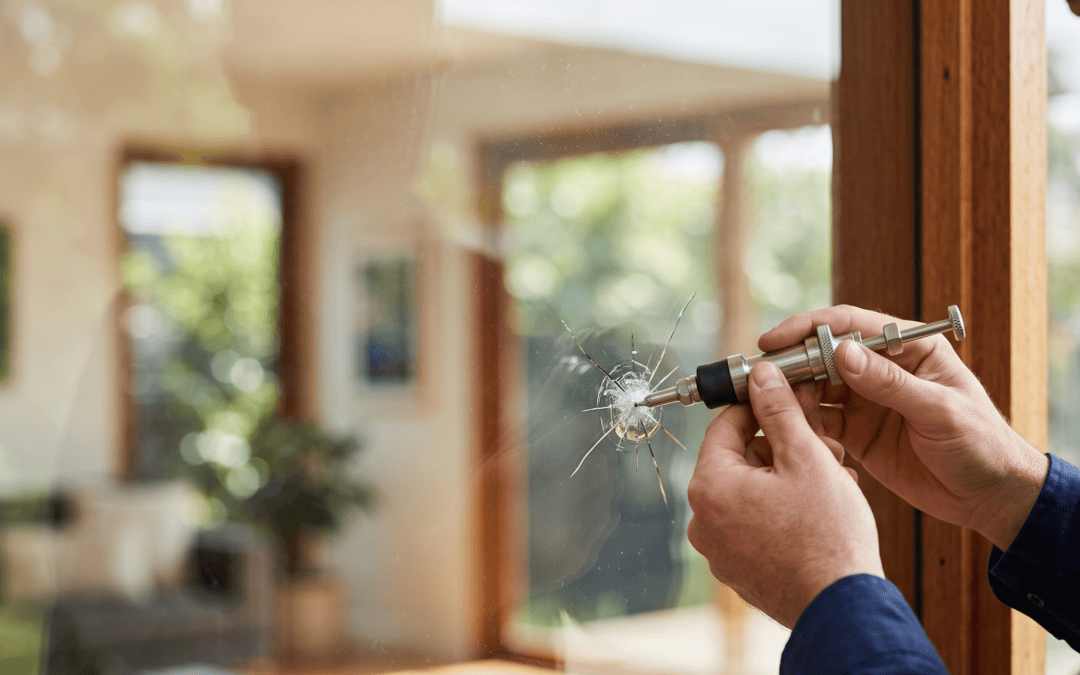
“Can you just repair it?” is one of the first questions homeowners ask when they call about a cracked window or door panel. It is a fair question. Repair sounds cheaper, faster, and less disruptive than a full replacement.
The honest answer is: sometimes yes, but usually no. And the difference between the two comes down to a few specific factors that are easy to assess once you know what to look for.
This article gives you a clear framework for determining whether your cracked glass can be repaired or whether replacement is the only safe and practical option. No vague “it depends.” Just the criteria that a licensed glazier uses to make the call.
When Repair Is Possible
Glass repair (as opposed to replacement) is only viable in a narrow set of circumstances. All of the following conditions need to be true:
The Glass Is Float (Annealed) Glass
Standard float glass, the type found in many older windows, picture frames, and some non-impact-rated locations, can sometimes accept a repair. Small chips and surface scratches in float glass can be filled or polished to restore appearance, though the structural integrity of the panel is not fully recovered.
Repair products for float glass include clear resin fillers (similar to windscreen chip repair) and polishing compounds for surface scratches. These can reduce the visibility of minor damage and slow the progression of a small crack.
However, float glass in a location that requires safety glass (near a door, below 800mm, in a wet area) should not be repaired at all. It should be replaced with compliant toughened or laminated safety glass. Repairing non-compliant glass just extends the life of a panel that should not be there.
The Damage Is Cosmetic Only
A surface scratch or a very small chip (less than 5mm) that does not penetrate through the full thickness of the glass is cosmetic damage. It looks bad, but it does not significantly reduce the panel’s structural capacity.
Cosmetic repairs are reasonable for:
- Small surface chips from minor impacts (gravel, hail, a bouncing ball)
- Shallow scratches from cleaning with abrasive materials
- Minor edge chips that are contained within the frame and not under stress
The repair improves appearance but does not restore the glass to “like new” condition. The repaired area will still be visible under certain lighting conditions.
The Crack Has Not Reached the Edge
A crack that starts in the body of the glass (away from the edges) and has not yet reached the edge of the panel may be stable enough to monitor temporarily. But “monitor” is not the same as “repair.” No resin filler or polishing compound will stop a crack from growing. Temperature changes, wind pressure, and vibration all put stress on the crack tip, and growth is a matter of when, not if.
If you have a crack that has not yet reached the edge, the practical advice is to schedule a replacement promptly rather than waiting for it to get worse and potentially shatter.
When Replacement Is the Only Option
In most of the situations we encounter, replacement is the correct path. Here is why:
Toughened Glass Cannot Be Repaired
This is the most important point in this entire article.
If the cracked or damaged glass is toughened (tempered) safety glass, repair is not an option. Period.
Toughened glass is under high internal tension by design. This tension is what gives it four to five times the strength of float glass and what causes it to break into small, safe fragments when it fails. But this same tension means that any crack, chip, or penetrating damage destabilises the entire panel.
A chip in toughened glass creates a stress concentration point. The internal tension pulls at the damaged area from all directions. The panel can shatter without warning, sometimes hours, days, or weeks after the initial damage.
There is no filler, resin, or compound that can counteract the internal stress of toughened glass. The only safe response to damage in a toughened panel is replacement.
How to tell if your glass is toughened: Look for the AS/NZS 2208 stamp etched or printed in one corner. If the glass is in a door, beside a door, below 800mm, in a shower, or in a balustrade, it is almost certainly toughened (or should be).
Laminated Glass With Interlayer Damage
Laminated glass can crack without shattering because the plastic interlayer holds the fragments together. This is by design and is the reason laminated glass is used in car windscreens, overhead glazing, and security applications.
A cracked laminated panel can remain in place temporarily because the interlayer maintains the barrier. But the panel’s structural capacity is reduced, and the interlayer is now exposed to moisture and UV through the crack. Over time, the interlayer degrades, delaminates, and the panel loses its ability to hold together.
Cracked laminated glass should be replaced, not repaired. The interlayer cannot be re-bonded once it is compromised. The temporary stability it provides is exactly that: temporary.
Cracks That Have Reached the Edge
Any crack that extends to the edge of the glass panel has compromised the panel’s structural integrity. The edge is the most stress-sensitive area of any glass panel (toughened or float). A crack at the edge means the panel can no longer resist wind loads, thermal stress, or impact at its rated capacity.
Edge-to-edge cracks also tend to grow rapidly because the stress at the edge is higher than in the body of the glass. A crack that reaches the edge today may spider-web across the entire panel within days.
Cracks Caused by Structural Stress
If a crack appeared without any obvious impact (no one hit the glass, no storm, no ball), it is likely a stress crack. Stress cracks are caused by:
- Thermal stress (uneven heating across the panel from sun exposure)
- Frame stress (a shifted or warped frame putting pressure on the glass edges)
- Settlement stress (the building settling or moving, transferring force to the glass)
Stress cracks typically start at the edge and run in a straight or gently curving line across the panel. They do not radiate from a central impact point.
A stress crack means the glass is under ongoing load that it cannot sustain. Repairing the glass without addressing the underlying cause (frame adjustment, thermal management, structural assessment) will result in the new or repaired glass cracking again.
Multiple Cracks or Spider-Web Patterns
If the glass has multiple cracks radiating from an impact point (a spider-web pattern), the panel is structurally failed. This pattern indicates that the glass absorbed more energy than it could handle and redistributed the force across multiple crack lines.
Spider-webbed glass is unstable. Any additional force (wind, vibration, someone leaning against it, a door slamming nearby) can cause the remaining pieces to collapse. Replacement is the only safe option.
The Decision Framework
Here is a simplified way to determine repair vs replace:
Replace if:
- The glass is toughened (has the AS/NZS 2208 stamp)
- The crack reaches the edge of the panel
- The crack appeared without impact (stress crack)
- There are multiple cracks or a spider-web pattern
- The glass is in a human impact area and is not safety glass
- The laminated interlayer is damaged or delaminating
- The panel is in a door, shower screen, balustrade, or pool fence
Possibly repair if:
- The glass is standard float glass (not toughened, not in a safety location)
- The damage is a single small chip (under 5mm) that has not cracked further
- The damage is a shallow surface scratch
- You are monitoring the damage while scheduling a replacement
Even in the “possibly repair” category, repair is a temporary measure. It slows deterioration and improves appearance, but it does not restore the glass to its original strength.
What About Windscreen-Style Repair Kits?
Windscreen chip repair kits are available at automotive stores and online. Some homeowners try using these on house windows. The resin and technique are similar in principle, but windscreen glass and building glass are different products in different applications.
Car windscreens are laminated glass held in a flexible frame that absorbs vibration and movement. Building glass is typically toughened glass in a rigid frame under different stress conditions. Windscreen repair resins are formulated for automotive laminated glass and may not bond correctly or cure properly in building glass applications.
More importantly, repairing building glass with an automotive kit does not address compliance. If the glass should be toughened and is not, or if the repair hides damage that makes the panel unsafe, the repair is worse than useless. It creates a false sense of security.
Get Your Glass Assessed
If you have a cracked window, door, or glass panel and you are not sure whether it needs repair or replacement, contact our team for a professional assessment. We will tell you what the damage means, whether the glass is compliant, and what the replacement involves. We service homes and businesses across Wollongong, Sydney, the Illawarra, and the Southern Highlands.
Recent Comments