
When a glass panel breaks at a commercial property, the instinct is to fix it fast. Find someone cheap, get it done today, move on. For a lot of building maintenance tasks, that approach works fine. Glass is not one of them.
Commercial glass repair and replacement is governed by Australian Standards, work health and safety legislation, and building codes that do not care whether the person doing the work is licensed or not. The standards apply to the finished result. If the glass fails and someone is injured, the question is not “who installed it?” The question is “was it compliant?” And if it was not, the business owner is exposed.
This is not a theoretical problem. It is a documented, recurring issue across NSW commercial properties, and it is the reason that insurers pay close attention to how glass work is carried out.
What Makes Commercial Glass Different
A residential window replacement is a relatively contained job. The glass goes into a frame, the frame is in a wall, and the consequences of a mistake are usually limited to a poor fit, a draft, or an aesthetic issue.
Commercial glass operates at a different scale:
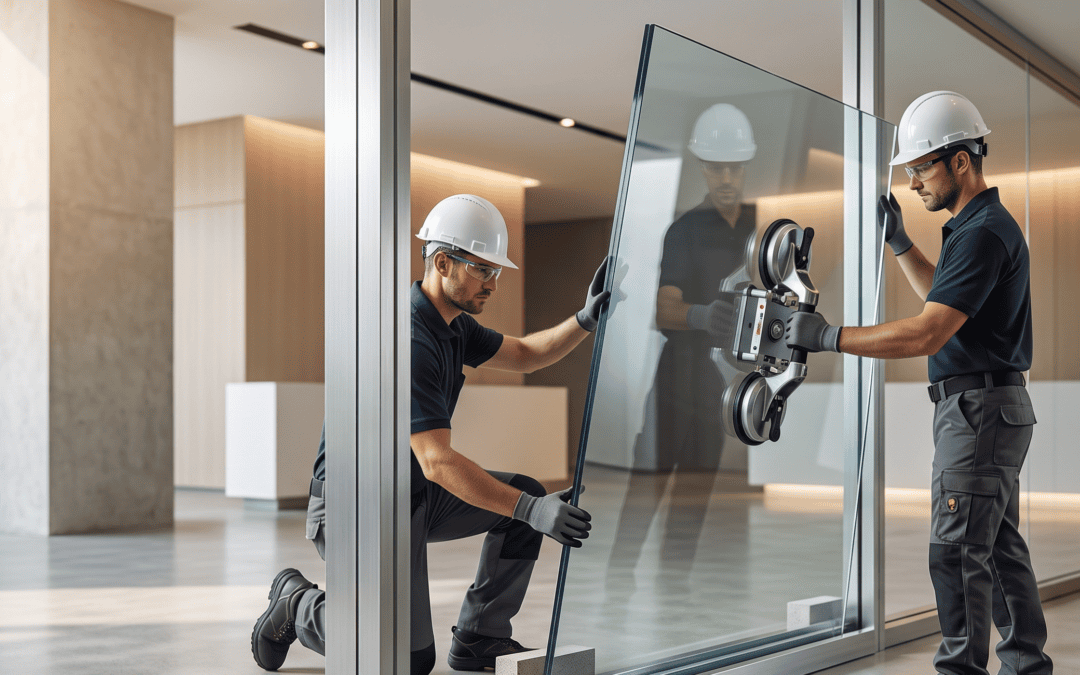
Panel sizes are larger. Shopfront panels, glass partitions, and balustrades are often 2 metres or more in height and can weigh 50kg to 100kg or more. Handling panels this size safely requires training, equipment (vacuum lifters, A-frames, protective gear), and a minimum of two experienced installers.
The glass is thicker. Commercial panels are typically 10mm or 12mm toughened glass, compared to 4mm to 6mm for most residential windows. Thicker glass is heavier, harder to handle, and more expensive to replace if damaged during installation.
The environment is public. A shopfront, an office, or a hospitality venue has foot traffic. Workers, customers, visitors, and members of the public pass by the glass daily. The consequences of a failure are not limited to the building owner. Anyone nearby is at risk.
The compliance requirements are stricter. AS 1288, the Building Code of Australia, and WHS legislation all impose requirements on commercial glass that go beyond residential standards. Safety glass selection, manifestation markings, overhead glazing rules, fire ratings, and structural load requirements all apply.
What Happens When Unlicensed Work Goes Wrong
Here are the failure scenarios we see from commercial glass work done by handymen, building maintenance staff, or unqualified contractors:
Wrong Glass Type
The most common and most dangerous mistake. A non-safety glass panel installed in a human impact area (a door, a sidelight, a low window, a partition) will break into large, sharp shards instead of small, blunt fragments. A person walking into or falling against this glass faces a serious laceration risk.
We have been called to commercial properties where previous maintenance staff replaced a broken safety glass panel with float glass from a hardware store because it was cheaper and available immediately. The replacement looked identical. It functioned identically. But it was non-compliant and dangerous from the moment it was installed.
The only way to verify glass type is the AS/NZS 2208 stamp etched in the corner. No stamp means no proof of compliance.
Incorrect Installation
Glass that is not seated correctly in its frame, channel, or fixing hardware is under uneven stress. Over time, this stress can cause the panel to crack or shatter without any external impact. This is called a spontaneous failure, and it is almost always caused by installation error rather than a glass defect.
Common installation errors include:
- Glass resting directly on a hard surface (metal, concrete) without setting blocks or gaskets
- Uneven clamping pressure from spigots or channels
- Panels installed without adequate expansion clearance
- Fixings tightened beyond the manufacturer’s specified torque
A licensed glazier understands these requirements because they are trained and examined on them. A handyman or maintenance worker may not even know that setting blocks exist, let alone why they matter.
No Compliance Documentation
When a licensed glazier replaces a commercial glass panel, they provide documentation confirming the glass type, the standard it complies with, and the details of the installation. This documentation is critical for:
- Insurance claims (proof that the glass was compliant at the time of installation)
- Building compliance records (required by the building owner or body corporate)
- WHS due diligence (evidence that the PCBU took reasonable steps to maintain a safe workplace)
- Lease obligations (proof that the tenant maintained the premises to the required standard)
Unlicensed installers do not provide compliance documentation because they are not qualified to certify that the work meets Australian Standards. Without documentation, the business owner has no paper trail to support a future claim or defend against a liability action.
What Insurers Think About It
Insurance is the practical reality check that makes this issue concrete for business owners.
Public Liability
If a customer, worker, or visitor is injured by glass at your premises, your public liability insurance is the first line of defence. The insurer will investigate the incident, and one of the questions they will ask is whether the glass was compliant with Australian Standards at the time of the injury.
If the glass was installed by an unlicensed person, was the wrong type, or was non-compliant in any way, the insurer may:
- Reduce the payout based on contributory negligence by the property owner
- Deny the claim entirely on the grounds that the risk was known or should have been known
- Seek to recover costs from the business owner if the insurer is required to pay the injured party
None of these outcomes are good. All of them are avoidable by using a licensed glazier for every glass installation and replacement.
Glass Breakage and Property Insurance
Most commercial property and glass breakage policies require that repairs and replacements be carried out by a licensed or qualified tradesperson. The exact wording varies by policy, but the intent is consistent: the insurer expects that work is done to a professional standard.
If you file a claim for glass damage and the insurer discovers that the previous replacement was done by an unlicensed person using non-compliant glass, the claim may be complicated or denied. The insurer’s position is that the non-compliant glass was a pre-existing defect, not an insured event.
Premium Impact
A glass-related injury claim on your record can increase your public liability premium significantly. An injury caused by non-compliant glass, where the non-compliance was preventable, is even worse. It signals to the insurer that the business does not manage its building risks adequately, which translates directly to higher premiums.
The Cost Argument Does Not Hold Up
The reason business owners use unlicensed installers is almost always cost. A handyman charges less per hour than a licensed glazier. The glass from a hardware store costs less than factory-ordered safety glass.
But the total cost equation includes:
The glass itself. Non-safety glass is cheaper, but it does not comply. If an inspector or insurer flags it, you pay for the compliant replacement anyway, plus the cost of the original non-compliant panel. You pay twice.
Liability exposure. A single injury caused by non-compliant glass can result in a claim that exceeds the cost of every glass installation your business will ever need. Workers compensation claims, public liability claims, and WHS prosecutions are measured in tens or hundreds of thousands of dollars.
Business interruption. If an incident results in a WHS investigation, your premises may be closed or restricted until the investigation is complete and the glass is rectified. The cost of lost trading days dwarfs the cost of doing the job properly in the first place.
Reputation. A glass injury at your premises becomes a news story, a Google review, and a workers compensation record. The reputational damage is difficult to quantify but easy to prevent.
What to Do Instead
The alternative is straightforward: use a licensed glazier for every commercial glass repair and replacement. The cost premium over unlicensed work is modest (often less than the difference business owners assume), and it buys you:
- Compliant glass (correct type, correct thickness, correct installation)
- Professional handling (trained installers with the right equipment)
- Compliance documentation (paper trail for insurance, WHS, and lease requirements)
- Warranty coverage (manufacturer’s warranty on the glass, installer’s warranty on the workmanship)
- Peace of mind (the job is done to the standard that the law requires)
Book a Commercial Glass Replacement
If you need glass replaced at your commercial premises and you want it done properly with full compliance documentation, contact our team. We are licensed glaziers and AGGWA members servicing commercial properties across Wollongong, Sydney, the Illawarra, and the Southern Highlands.
Recent Comments